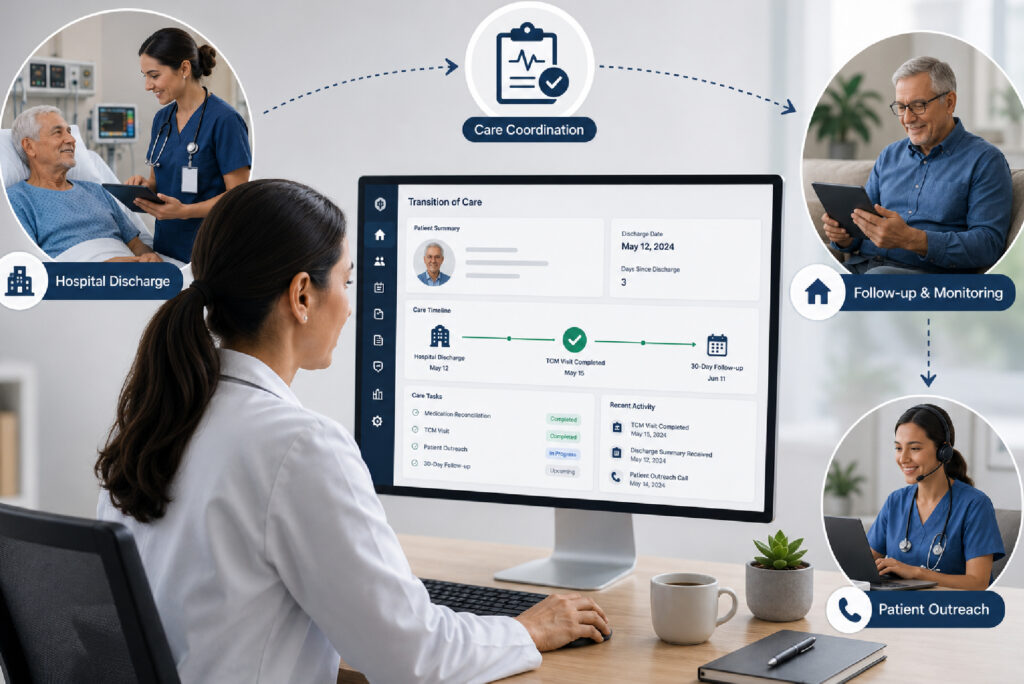
Remote Therapeutic Monitoring Software for Post-Discharge Care Coordination
Support Medicare-compliant Transitional Care Management workflows with structured follow-ups, care coordination, and documentation for post-discharge patients.
Why Transitional Care Management Matters
Transitional Care Management is a critical CMS-supported care model designed to improve outcomes after patient discharge from hospitals, emergency departments, and skilled nursing facilities.
Most care gaps occur after discharge, where patients often experience:

Missed follow-up
visits
Incomplete medication reconciliation

Poor care
continuity
Lack of structured communication
Increased readmission risk

TCM ensures structured, timely follow-up during this high-risk transition period.
What is Transitional Care Management?
Transitional Care Management (TCM) is a Medicare reimbursement-supported care model focused on structured post-discharge coordination.
It requires:
- timely patient follow-up after discharge
- medication reconciliation and review
- coordinated communication between providers
- documentation of care transition activities
- continuity of care planning
The goal is simple: reduce avoidable readmissions and improve recovery outcomes.
Medicare TCM Billing Codes
TCM services are reimbursed under CMS codes:
Moderate complexity care transition requiring medical decision-making of moderate intensity.
High complexity care transition requiring medical decision-making of high intensity.
Qualification Requirements
- ✓ Timely post-discharge contact
- ✓ Structured follow-up visits
- ✓ Care coordination activity
- ✓ Accurate recordkeeping
Key Workflow Capabilities

Post-Discharge Tracking
Identify and monitor patients eligible for TCM workflows.
Medication Reconciliation Support
Ensure accurate medication review after discharge.
Follow-Up Scheduling
Support timely TCM visits within CMS requirements.

Documentation Support
Maintain structured records for 99495 / 99496 compliance.

Care Coordination
Improve communication between PCPs, specialists, and care teams.
Patient Risk Visibility
Identify high-risk patients early in transition period.
Operational & Financial Impact
- Improve follow-up completion rates
- Increase eligible Medicare reimbursement capture
- Reduce administrative tracking burden
- Improve care coordination efficiency
- Minimize missed transition cases
Supports revenue integrity and clinical efficiency.
Clinical Outcomes Impact
- Reduced hospital readmissions
- Improved medication adherence
- Better post-discharge recovery outcomes
- Stronger patient engagement during transitions
- Improved continuity of care
Who This Supports
Why Modern Practices Use TCM Platforms
Modern systems unify fragmented communication and manual tracking into a single source of truth.
🔄 Value-Based Care Alignment
TCM directly supports value-based care by improving continuity of care, reducing readmissions, and ensuring high-quality execution of structured follow-up protocols.
Frequently Asked Questions
What is Transitional Care Management?
TCM is a Medicare program focused on structured post-discharge care coordination and follow-up.
What are TCM billing codes?
99495 and 99496 are CMS reimbursement codes for transitional care services.
Who qualifies for TCM?
Patients discharged from hospitals, emergency departments, or skilled nursing facilities.
Is TCM a software?
No. It is a care model. Software only supports its execution.
Improve Transitional Care Management Workflows
Support structured post-discharge care coordination, improve follow-up execution, and ensure Medicare-compliant documentation across your practice.